
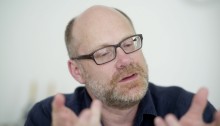
Johannes Holzhausen in an interview with Claus Philipp: In your opinion, what is the purpose of a museum? Johannes Holzhausen: I guess for me a museum is like Noah’s ark, a place where things are preserved and are carried across the ocean of time into the present. So each museum is also a compact version of the world.
In other words, in this system there’s already a montage of the “world”, which you, as a filmmaker, can refer to in your work.
Yes. This world is composed of objects: museums have things that they preserve and these objects are from the depths of time. And then there are also individuals involved: people who handle the objects, reflect on them and imbue them once again with spirit and meaning.
The work of these people gives back value to the objects.
That was one of the ideas behind this film: to show that objects never exist in isolation but always in the context of someone’s work. Before they are worthy of being filmed, as it were, something must be done with them. It was never my intention to explain art, but rather to show how art is arranged. And also the thought process behind it.
What were your first experiences at the Kunsthistorisches Museum?
Depressing. I had just come from Salzburg to study art history in Vienna. It was kind of compulsory to make regular visits to the museum. The architectural setting where the art is
(re-)presented made me weary – it kind of weighed me down. I found the imperial gesture inscribed everywhere rather taxing and this led to a feeling of tiredness. I always felt like lying down on the benches and taking a nap. But once you’re standing before a piece of art, all those feelings disappear.
How come you studied art history?
On the one hand, I didn’t know what to do with myself after school. And on the other, because of a Ludwig Kirchner exhibition I’d gone to in Munich when I was 16. I grew up without learning anything about art – and then suddenly I saw those paintings. It was like opening a door to a whole new world for me. It immediately got me curious and I wanted to learn more about it. So I decided to study art history. I also saw it as a kind of enlightenment: Art can lead to enlightenment. And that was what brought me to film. Stadtkino opened around the time I came to Vienna. I went to every single film they screened there. And I saw a Robert Bresson retrospective in Munich. It was the same experiences I’d had with fine arts: Every time I left the cinema, I would have a new perspective on the world.
One could postulate that it’s impossible to plan a film like the one you’ve just finished as a long-term project. There’s always the chance that every new impression, each new “scene” will change the intended “narrative”. How do you prepare a film with the title THE GREAT MUSEUM?
Here, too, it all started with curiosity. For example, I know someone who worked as a restorer at the KHM and had the opportunity to watch him restoring a Titian. It was amazing. They spend two years working on one painting, square millimetre by square millimetre. You have this microcosm and are so physically close to the pigment. Then you take a few steps back and see the picture…
Like a jigsaw puzzle ...
Yes, but with about a thousand times more pieces. That’s how he saw the picture. And he knew everything about it. And the fact that he actually touched the painting really intrigued me. Years later, when Sabine Haag was appointed director of KHM, I thought – quite pragmatically – that it was the right time to make a film like this and started to do the research together with my co-writer Constantin Wulff. Pretty early on, one of the art historians pointed out to us that the museum draws a peculiar line between the country’s imperial past and the republic. We thought: We have to find a picture to express this. We hoped that a situation would arise during the scheduled shoot which would underpin this assumption. So we kept our eyes and ears open, hoping to find something. In a shoot like that one, this is what you could call the planned part in an unplanned process – a much sought-after coincidence. In this case, the coincidence was that paintings from the office of the Federal President were taken down for restoration and then brought back. This fairly banal situation was the source of a narrative thread. It wouldn’t have interested me if I hadn’t planned to explore the lines drawn between the past and present system of government in Austria.
It’s a truism that documentary filmmakers also invent fictions when they create scenes simply by pointing their camera at something. Could you tell us something about the scenes that you “invented” for this film?
The fact that the presence of the camera influences a situation can also be positive. It is an element that often accentuates things or situations, no matter how hard you try to be subtle and hide in the corner while filming. Simply knowing that a camera is there changes the emotional state of the people being filmed. Conflicts often become more visible because in front of the camera people tend to express themselves in terms of “now or never”. Sometimes we also used the camera in a quite pushy manner to create a certain situation. This was often the case when people were working on objects, which is an intimate situation per se. People are absorbed in handling the object and so it’s quite easy to position the camera and even give instructions. Of course, the instructions have to be geared to that particular person. So if you have the right tone and the right attitude, you can get something out of the situation, which otherwise might not have revealed itself, although it was always present. One of the joys of my work is to pinpoint the dramatic potential of a situation and tease it out.
Let’s talk about two particular scenes from your film: One which seems to arise naturally from the situation – at lease from the audience’s point of view: a discussion about KHM’s marketing design and fonts; and the other, where a workman is destroying the parquet floor of a room.
You just pointed out the two different sides of my work. One side involves patiently waiting for a moment when something exposes itself – you cannot plan this. You can only hope and keep on shooting and shooting until it happens. In my opinion, persistence is essential. You have to keep on investigating and probing and if something doesn’t work out, you have to try it again and again and again until you find what you were looking for. The other side is more rewarding – at least during the shoot. It’s when you can capture everything in a single moment; I can focus the camera and set the frame and I determine everything that happens, every detail of the composition. To come back to your example: the workman was there to remove the parquet floor. So we were able to set up the camera, arrange the frame and then I just told him where to start his work. Usually he’d start from a corner and not in the middle of the room. By the way, he really disliked having to smash the beautiful parquet floor.
What would you say is your special talent? Building up relationships of trust? After all, you didn’t plan to make a PR movie for KHM. The museum is depicted in all its ambivalence. Nevertheless, the people who work there say they’re happy you didn’t paint them in a bad light.
Trust helps me create the space I need to move. And I’d never ever betray that trust. I feel I owe it to these people. The more trust someone puts in me, the more obliged I feel to keep that trust. And the greater the limitations, the more I try to break through and sidestep them. The more trusted I feel, the harder I try not to disappoint that person. I then try to capture something that represents that person, that’s true to them. So it’s a great sign of approval when someone says: “I’d never thought of myself like that, but it’s true.” That’s a great compliment for me.
Your first film ON THE SEVEN SEAS was quite different from THE GREAT MUSEUM. However, there is a common motif: Old battleships with a long history, which are now faced with the question of whether they are worthy of being preserved. Where do you get your passion for objects that are worthy of being preserved? Is there a key childhood memory where you’d say:
I wish that had been preserved?
I’ve never delved that deeply into my own mind. But lately I’ve also been wondering: What’s the common thread in my works? Are they rooted in my early childhood? My family is, of course, a big influence: I come from an upper-class, aristocratic background and in my family it was perfectly normal that my great-great-great-grandfather had accomplished something extraordinary. To shake off this background and find my own identity was a long, internal process. The past always influences us.